Defining Your Distinctive Brand Strategy | Visionary Brand

Malcolm Gladwell once compared the word brand to the word Africa. Both can mean so many different things that two people can use the same word while imagining entirely different…
Malcolm Gladwell once compared the word brand to the word Africa. Both can mean so many different things that two people can use the same word while imagining entirely different realities.
The same is true of brand.
For one person, a brand means a logo. For another, it means advertising. Someone else might think of a name, a website, social media, packaging, or a campaign.
All of these are expressions of a brand.
But none of them, on their own, are a brand strategy.
Brand strategy is the thinking that connects all of these elements. It defines who you are, who you want to matter to, why you should matter to them, and how you will consistently communicate that difference.
Without that clarity, businesses end up reacting to the market instead of shaping it.
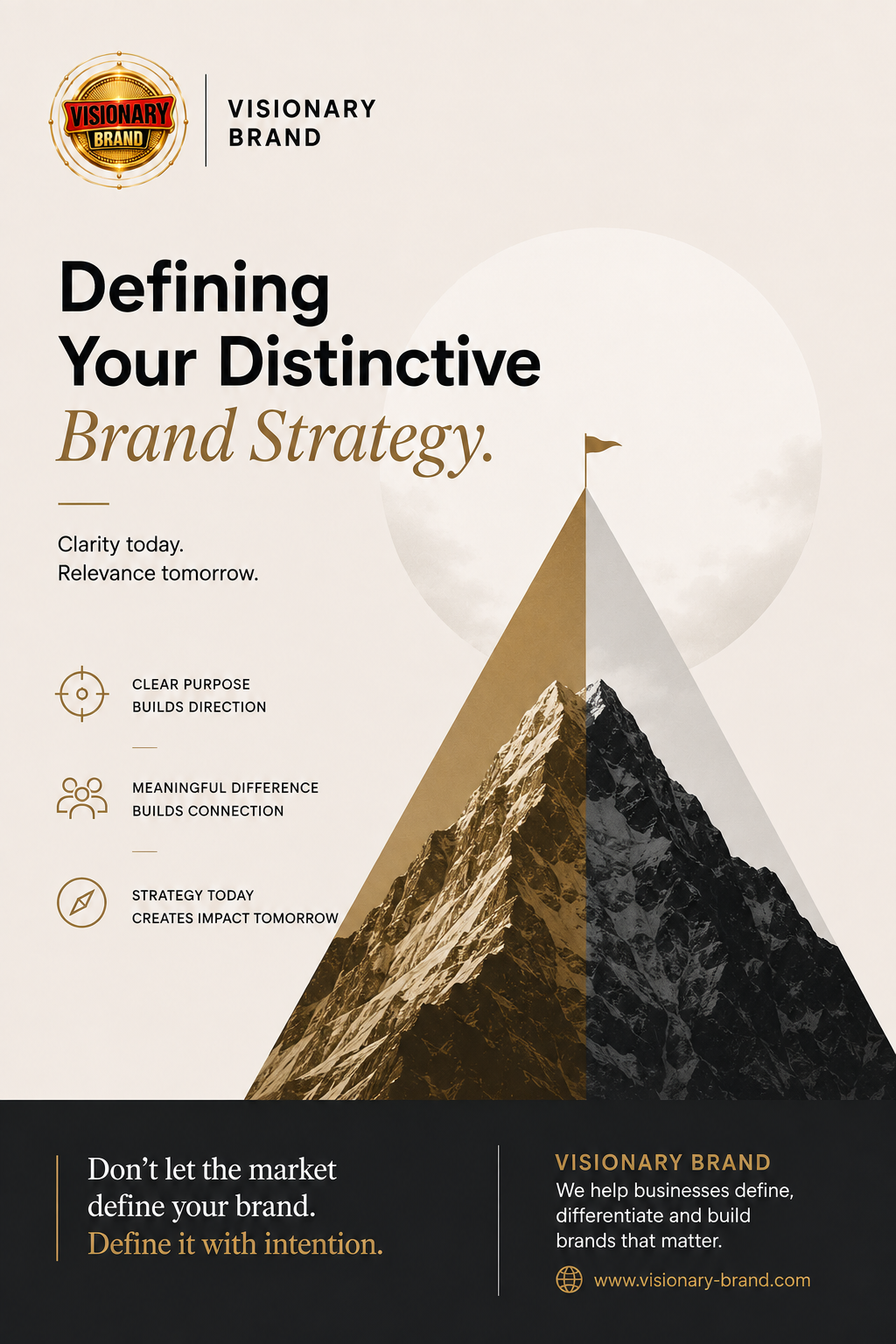
The market is changing. Your brand strategy cannot stand still.
Society, technology, consumer behaviour, and marketing are evolving faster than most organisations are built to handle.
New platforms emerge. Customer expectations shift. Categories become crowded. Competitors can build an audience overnight. What worked two years ago can quickly become irrelevant.
This creates risk, but it also creates opportunity.
Smaller, more agile brands can challenge established players because they can move faster, make sharper decisions, and build stronger relationships with their audiences.
Established brands have their own advantages. Scale, trust, distribution, data, and resources can become powerful assets when combined with the willingness to adapt.
The winners will not necessarily be the biggest brands.
They will be the brands that understand where the market is moving and have the strategic clarity to move with it.
Distinction comes before differentiation
Many brands try to differentiate through what they do. They launch a new campaign, redesign their identity, change their tagline, or invest more heavily in social media.
That is backwards.
Before deciding how your brand should look or communicate, you need to decide what you want it to mean.
A distinctive brand strategy should answer five fundamental questions:
Who are we?
Who are we trying to matter to?
What do we want to be known for?
Why should people believe us?
What makes us meaningfully different?
Once these answers are clear, your identity, messaging, campaigns, content, experiences, and channels have a strategic role to play.
Without those answers, they are simply marketing activities.
Do not let the market define your brand
Every interaction with your business contributes to how people perceive you.
If you do not deliberately shape that perception, the market will do it for you.
Your competitors will position you.
Your customers will describe you.
Your employees will represent you.
Your campaigns will create associations.
Your inconsistencies will become part of your identity.
That is why brand strategy is not a cosmetic exercise.
It is a business decision.
A distinctive brand gives an organisation something more valuable than recognition. It gives people a reason to choose you, remember you, and believe in you.
In a market where everything is changing, the brands that endure will not be those that simply keep up.
They will be the ones with enough clarity to know what should never change and enough courage to change everything else.
Build a brand the market cannot easily confuse.
Visionary Brand helps businesses define, differentiate, and build brands designed to matter.
8169773708
📍 Innov8 Co-working, R City Mall, Ghatkopar, Mumbai
Don't just rent attention. Build people who believe in your brand.
Make credibility visible.
Apply for verification